
Yarn Bowl or Yarn Spinner: Which Should You Choose?
A side-by-side look at the yarn bowl and the yarn spinner (spinning yarn holder): tension, stability, travel, upkeep and the mistakes to avoid, so you can pick the one that fits the way you crochet or knit.

If you crochet or knit often, sooner or later you wonder whether you need a yarn bowl or a yarn spinner. Both solve the same problem: they stop the ball rolling across the floor, getting dirty and making you stop every other row. But they go about it in very different ways. A yarn bowl (you will also see it called a wool bowl, especially in the UK) holds the ball in a cavity and guides the yarn out through a slot or spiral. A yarn spinner, also known as a spinning yarn holder, lets the ball rotate on a plate or a mast as you pull.
We have worked with both formats and with yarns of different weights and fibres, and the conclusion is simple: there is no outright winner, only the format that fits each way of working. In this guide we explain how each one works, where it shines, how to choose without regrets and which mistakes to avoid. If you are still deciding what kind of holder you need in the first place, our overview of how to choose a yarn holder is a good starting point.
Contents
- What each one is and how it works
- Yarn tension, comfort and rhythm
- Stability, travel and upkeep day to day
- Materials and what to check before you buy
- Mistakes to avoid when choosing
- Using either one with the rest of your kit
What each one is and how it works
What a yarn bowl is
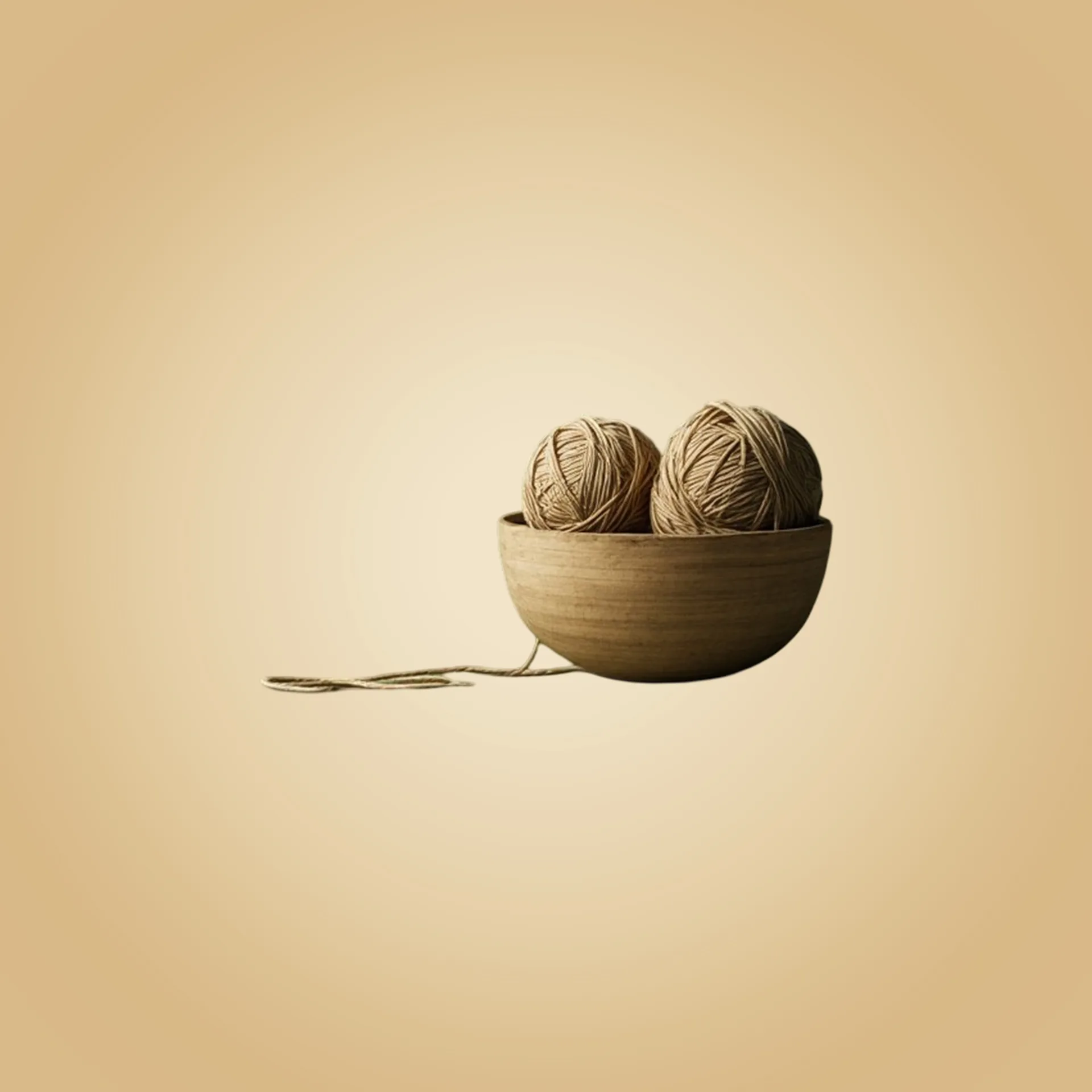
A yarn bowl is a piece, traditionally of wood, ceramic or bamboo, with a cavity where you put the ball and a slot or a spiral where the yarn leaves. The ball stays contained and protected and turns inside the bowl as you pull. The slot or spiral guides the yarn and stops it tangling with the rest of the ball. It is also a decorative object: many bowls end up as a small piece of craftsmanship on the table. Our “Abrazo” yarn bowl is 3D-printed in PLA/PETG and has a spiral guide with a rounded, polished edge and low non-slip feet. You drop the yarn cake in, thread the strand through the spiral without cutting the yarn, and slide the strand out when you want to change yarns.
What a yarn spinner is
A yarn spinner is a support with a steady base and a plate or mast that turns. You put the ball on top (or onto the mast, depending on the model), and when you pull the yarn the ball spins on its own instead of rolling along the table or the floor. The key is that the movement is controlled: the yarn leaves with a fairly even resistance, and you do not have to chase the ball around the room. Our “Dúo” spinning yarn holder has a flat, low base with non-slip feet, a plate, a removable mast and a metal ball bearing for a smooth turn. The set comes with the base, plate and mast, and the yarn is not included.
Yarn tension, comfort and rhythm
Yarn tension is probably the factor you notice most when you work, and the two formats behave differently. With a spinner, the yarn comes out with fairly constant resistance, because the ball turns on an axis. That helps you keep a regular rhythm, especially on long projects. With a bowl, the yarn comes out through the slot and the resistance depends on how the ball is sitting inside: if the ball is large and presses against the walls, you will feel more pull; if it is small, you will hardly notice it.
When each one suits your tension best
- Yarn spinner: a good choice if you work from large balls or tightly wound cakes, or if you like to keep a continuous rhythm without stopping to reposition the ball.
- Yarn bowl: a good choice if you prefer the yarn to be guided out through a slot and you work with medium or small balls that turn easily inside the cavity.
A common cause: if the yarn catches or suddenly tightens, it is almost always because the slot has a rough edge or because the ball is badly placed. On a spinner, the equivalent is an axis that does not turn freely or a base that has slipped. In both cases, check the accessory before blaming the yarn.
Stability, travel and upkeep day to day
This is where the balance tips depending on your routine. A yarn bowl usually wins on stability: its own weight and flat base keep it firm even on a small table or on the sofa. A spinner is often lighter and more portable, but it can slide if the surface is sloped or the base has poor grip. If you crochet at home in a fixed corner, a bowl gives a feeling of solidity that is hard to match. If you crochet at fairs, workshops, classes or on the road, a spinner is often more practical because it takes up less room and weighs less.
Travel: what goes in your project bag
If you tend to move around, think about space and protection. A solid wooden bowl can be heavy and bulky, and it is a good idea to wrap it so it does not get knocked. A spinner is usually more compact and easier to put into a project bag alongside the rest of your work. If you travel a lot, check also whether the mechanism of a spinner can be taken apart or whether it has parts that could come loose on the way.
Upkeep and care
- Yarn spinner: check the axis or bearing from time to time, clear the dust and make sure the plate turns without noise or jumps. Our spinning holder should be wiped with a dry or barely damp cloth and never submerged, because of the bearing.
- Yarn bowl: almost no maintenance. Wipe it with a dry cloth, avoid prolonged damp and check that the slot has no splinters. If the wood is untreated, an occasional suitable oil helps. Our bowl takes a dry or well-wrung damp cloth, not the dishwasher, and should be kept away from radiators and long direct sun.
In damp climates, unsealed wood can swell or crack. If you live somewhere humid or you carry the bowl around a lot, look for sealed wood or treated bamboo. It is a small detail that makes a difference in the long run.
Materials and what to check before you buy
Both formats come in very different materials, and that affects the price as well as the feel when you work. In wood, a bowl tends to be heavier and steadier; in plastic or resin, a spinner can be lighter and cheaper. Prices vary a great deal with finish and origin, so rather than looking for the cheapest, think about how much you will use it and in what conditions.
What to look at before you buy
- Edges and slots: no splinters and no rough burrs. Run a fingertip along them: if it catches your finger, it will catch the yarn.
- Base: on a spinner, check there is some kind of grip; on a bowl, that it is flat and does not rock.
- Size: if you often work from large balls, you need a roomy cavity or a generous plate. If you use small balls, a compact format will do.
- Mechanism: on a spinner, it should turn smoothly and, if possible, be easy to check or replace.
- Finish: on a bowl, the wood should be sanded and, where relevant, treated to resist damp.
A practical rule: if you work for more than an hour at a time and a ball lasts you several sessions, invest in an accessory that is really comfortable. If you work in short bursts and put the project away each time, put the priority on how easy it is to pick up and carry. We design and 3D-print our accessories in Torremolinos, so we know the difference between a piece that stands up to daily use and one that ends up in a drawer.
Mistakes to avoid when choosing
One of the most common errors is to buy for the yarn you use today and not the yarn you will use in a few months. If your basket changes format often, ask whether the system you choose will take round balls, elongated cakes, compact bobbins or even leftovers from earlier projects. Before you decide, look at which kind of ball dominates in your usual projects, and whether you often work with fine, medium or thick strands.
Another frequent slip is to look only at the outside and not at how the accessory behaves in a long session. A bowl that is too deep can make you put your hand in to reposition the ball every few stitches, and one that is too open lets the ball roll and tangle. With a spinner the risk lies in the mechanism: if it turns too easily the yarn can shoot out, and if it offers resistance you pull without noticing and strain your wrist. The practical test is to check, before you buy, whether the turn is smooth but controlled, whether the ball is held without being squeezed, and whether you can change ball without taking the accessory apart.
People also choose a holder that does not suit the place where they work. A bowl is heavy and takes up room, so if you crochet on the sofa, in bed or on the move, it can end up being something you leave at home. A spinner is more compact and easy to carry, but it needs a stable surface so that it does not tip while you work. Ask yourself where you will work most of the time, whether you will move the project from room to room and whether the accessory fits in your project bag without being taken apart. Resist buying the prettiest one on impulse before you have checked that it fits your real routine.
To get it right, a short list of practical checks helps:
- Check the ball goes in and comes out easily without having to unwind it.
- Check the yarn comes out without jerks or jumps, at the start and at the end of the ball.
- Ask whether the material can be cleaned with a damp cloth or needs special care.
- Make sure the base does not slip or mark the table.
- Choose a size that takes the largest ball you are likely to use, not just the smallest.
If you cannot decide, a sensible option is to start with the one that best fits your yarn and your place of work, and think about the other later as a complement. There is no accessory that is better in the abstract, only one that fits your way of working, your yarn and your space. Avoid buying two at once if you do not yet know which you find more comfortable, because you may end up using only one and keeping the other in a cupboard.
Using either one with the rest of your kit
A bowl or spinner does not work alone: it is part of a small workstation. If you work with several colours, our “Color Dúo” bobbin system keeps each colour in its own lane so the strands do not twist around each other. If you crochet with a range of hook sizes, a hook organizer keeps your tools within reach. And if you want to keep track of your rows without losing count, the “Una más” row counter is a simple helper on long projects: it is fully mechanical, with no batteries or app.
Tension is also something you can improve with practice. If your project calls for very even tension, check your swatch with our needle and swatch gauge, and when you finish the piece, a blocking board will help you reach the measurements you wanted. They are small accessories, but they work together. And if you want the full picture of how to block crochet and knitting, we have a guide for that too.
Learn more: if you are matching a holder to yarn of different thicknesses, the Craft Yarn Council's yarn weight system lists the usual weight names, from fingering to bulky, with the hook and needle sizes that go with each.
From the Mota & Nudo workshop in Torremolinos, where we design and 3D-print our accessories: you will find our yarn bowls and spinning yarn holders in one collection and our organizers in another. Whichever you pick, we hope it keeps you company on every project. Better Together.
Frequently asked questions
Which is better, a yarn bowl or a yarn spinner?
It depends on how you work. If you crochet at home in a fixed spot and want stability and a protected ball, a yarn bowl is usually the more comfortable choice. If you work on the move, at meet-ups, classes or while travelling, a spinner can be more practical because many are smaller and lighter. There is no single answer, only the format that fits your routine.
Does a yarn bowl work with large balls of yarn?
Yes, as long as you choose a model with a roomy cavity. If a big ball presses against the walls of the bowl, you will feel more resistance when you pull and the ball will struggle to turn. In that case a spinner with a generous plate may be more comfortable. Check the inner measurements and think about the size of the balls you normally use.
How do I stop the yarn catching in the slot of a bowl?
First, check the slot is well polished, with no splinters or rough edges: run a fingertip along it, because if it catches your finger it will catch the yarn. Second, place the ball so the yarn leaves through the slot without crossing over the ball. Third, keep the bowl clean and dry. If the slot is narrow and your yarn is thick, look for a model with a wider opening.
Can a spinner be used with any ball of yarn?
In general yes, but check the size of the plate or the support. Very small balls may sit still and not turn, and very large ones can spill over the plate. A tightly wound ball can also give more resistance. If you are in doubt, try it with the ball you use most before you decide.
Is it worth having both?
If you craft a lot and in different settings, it can make sense. Many people keep a bowl at home, as part of their craft corner, and a spinner to take on trips or to classes. Each format solves a specific situation. If you want only one, think about where and how you work most of the time and choose the one that fits.