
Crochet Hook Organizer: What Size Do You Need?
How to pick a crochet hook organizer that fits your collection and the way you work: how many hooks to plan for, which format suits you, and what to look for in compartments, closures and materials.

When you first start to crochet, a crochet hook organizer can feel like a luxury. Then one day you have ten hooks of different thicknesses, a pair of scissors, stitch markers, a yarn needle and a couple of loose balls rolling around the table, and the organizer stops being an extra and becomes a necessity. Choosing the right size is what makes the difference between having everything to hand and spending half the evening looking for your 4 mm hook.
There is no standard size. A small organizer is ideal if you crochet on the sofa with four hooks, but it falls short if you teach or travel between meet-ups. A huge organizer is awkward if you have little to put in it. The trick is to measure your real situation: how many hooks you actually use, whether you carry yarn with you, and whether the organizer has to travel. This guide covers capacity, formats and materials.
Contents
- Why size matters more than you think
- Start by counting your hooks and measuring the longest
- Compartments, pockets and closures
- Materials that stand up to daily use
- Case, desk rack or hanging: choose your format
- How to organise your hooks
- Fitting the organizer to the way you really work
Why size matters more than you think
People tend to think of a hook organizer as a place to put things away, but its size shapes how you crochet. If it is too small, the hooks squeeze together, the tips catch on each other and you end up leaving a few outside, which defeats the purpose. If it is too big, everything slides around, the pockets are half empty and you will not want to carry it. A well-sized organizer is one you reach for without thinking.
It also depends on what else you want to keep with the hooks. A set of hooks and a tape measure need very little space. Add scissors, yarn needles, markers, a row counter, a pattern folded in four and the odd small ball, and the capacity you need changes completely. Decide what the organizer will hold before you look at any measurements.
Start by counting your hooks and measuring the longest
The first figure you need is how many hooks you want to store. Not the ones lying at the back of a drawer, but the ones you use regularly. From there, the size of the organizer almost works itself out.
A small collection
If you own a handful of hooks plus scissors, yarn needles and a few markers, a slim case is all you need. It takes up little room on a side table and slips into a project bag. If your crochet travels with you to the park or the waiting room, a small organizer stops you from carrying more than you need.
A full set
If you own a complete range of sizes, you will want something mid-sized. This is the one we call the sweet spot: large enough to hold every hook, some small balls, a folded pattern and your helpers, and compact enough to move from one room to another. It is a comfortable choice if you crochet at home but also take your hooks to a class or a get-together with friends.
A big stash
If your collection includes several of each size, or hooks for different crafts, you are managing an inventory. A large organizer, often one that hangs, keeps lots of hooks, yarn and tools sorted by project or by thickness. It makes sense for anyone with a whole corner or room dedicated to making, because it uses vertical space and clears the table. If your collection grows every season, a larger format stops tools piling up in unsorted boxes.
Measure your longest hook
Capacity is only half the story: length matters too. An organizer that is too short leaves the tips sticking out, where they catch on other things, while one that is too deep makes you reach to the bottom to find what you want. Measure your longest hook and check that the organizer holds it without the tip sticking out awkwardly, and that your shorter hooks do not get lost in an oversized gap. If any of your hooks have thick or ergonomic handles, check that they fit the slots, because many are sized for slim handles.
Compartments, pockets and closures
The outside size is not the whole picture. How the inside is organised is what really makes the difference. These are the points worth checking before you choose an organizer.
Narrow compartments for hooks
Hooks should be held in place, not left loose. Look for individual slots or elastic loops that cover your full range of sizes without letting them mix. If you keep them all together in one big pocket, you will be rummaging for the one you need every time. A good organizer separates hooks by thickness, or at the very least keeps each one in its own place.
Roomy pockets for yarn and patterns
Auxiliary pockets are for small balls, a folded pattern, a gauge tool and scissors. They need to be deep enough that a small ball does not tip out the moment you move the organizer. Pockets with a little give in the sides keep the contents from spilling.
A zip or a flap
If you crochet outdoors or the organizer is going to travel, some kind of closure is essential. It protects against dust, damp and tools escaping. A good zip lasts for years, while a flap with a button or hook-and-loop strip is quicker to open but less secure. For heavy use, a zip is the safer choice.
A handle or a strap
If you move the organizer between rooms, classes or markets, the handle is not a small detail. Check that it is well stitched and that the weight does not pull on it. Adjustable straps let you carry it on your shoulder when it is full.
Materials that stand up to daily use
The material affects the weight, the cleaning and how long the organizer lasts. No single material suits everything, but some work better than others depending on use.
- Polyester or canvas: hard-wearing, easy to clean and light. They cope well with daily use and fold without creasing.
- Clear plastic: practical because you can see the contents without opening it. Handy if you keep lots of hooks and want to find them at a glance. Over time it can yellow if it sits in direct sun.
- Thick cotton or quilted fabric: nicer to look at and softer, but it gets dirty faster and weighs more. A good match if the organizer stays at home and you want something that goes with your craft corner.
If you crochet outdoors or in dusty places, clear plastic or canvas is the more practical choice. If it is going to be on show at home, thick cotton is a warm, pleasant option.
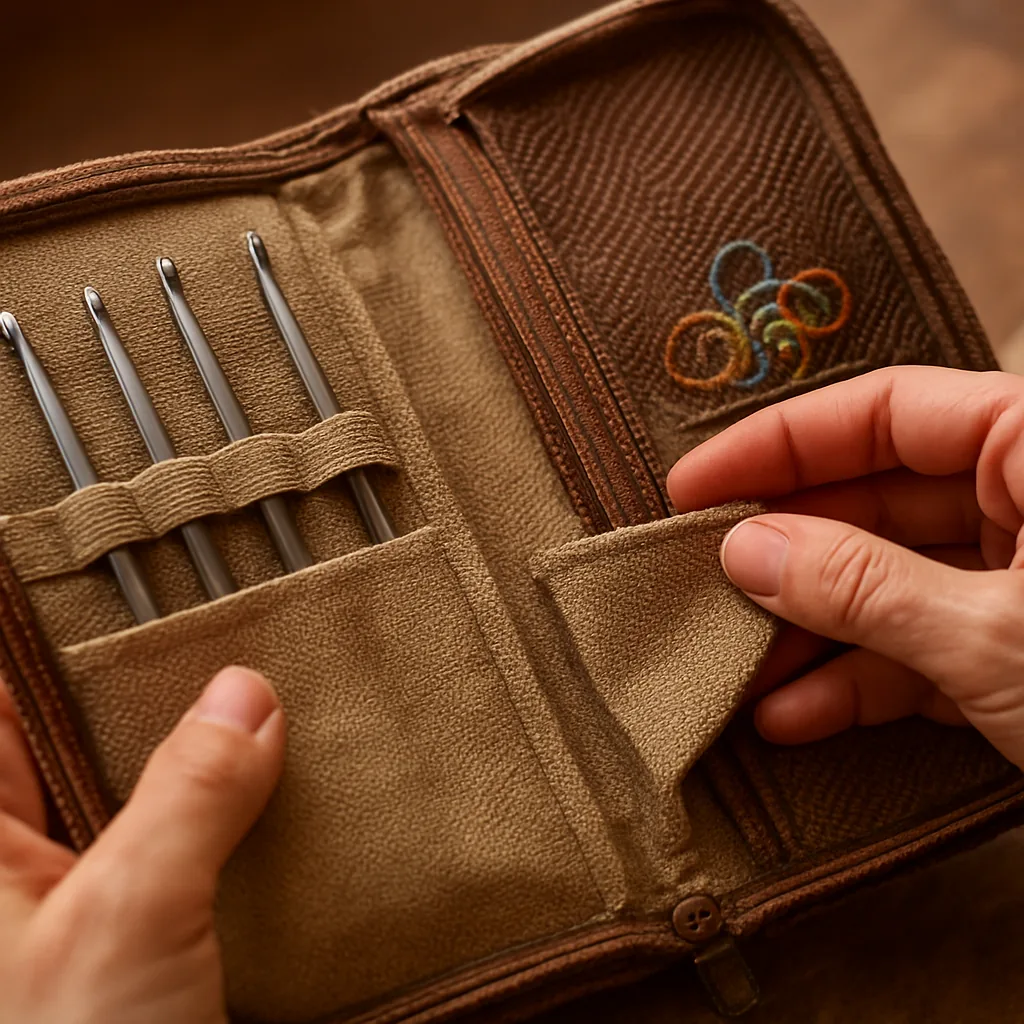
Case, desk rack or hanging: choose your format
Besides size, the format changes how you use it. An organizer that lies flat on the table is not the same as one that hangs on a wall.
Portable case or roll
It folds, closes and goes with you. It is the most versatile choice if you crochet away from home. It usually has narrow compartments and one central pocket. Keep an eye on the weight: if you overload it, the handle suffers. For this format, less is more.
Desk rack
It stays open on the table or desk. It has more capacity and shows everything at a glance. It suits you if you have a fixed corner for crochet and want everything to hand without getting up. A non-slip base keeps it still while you work.
Hanging organizer
It takes advantage of the height of a door or wall and is a sensible fix for small spaces with lots of tools. If you crochet in a shared room, it clears the table and keeps everything tidy. As we said above, check the fixings can carry the weight of a full organizer.
How to organise your hooks
One habit that works is to sort hooks into families by thickness: the fine ones in one section, the medium ones in another, and the chunky ones in a third. When you start a project, you know exactly where to look.
That idea is behind our “Todo en su sitio” hook organizer: twelve numbered slots on two tiers for hooks from 2.0 to 10.0 mm, with the number engraved in relief next to each hole so you find your 4.0 first time. The base is included; the hooks are not. For the small things, our “Todo conmigo” notions case keeps markers, yarn needles and a tape measure in separate sections inside your project bag, with a long channel for thin hooks and needles.
Small balls go in the pockets and larger ones in a separate “Abrazo” yarn bowl. If you work with several colours, our “Color Dúo” bobbin system keeps the strands apart. And do not forget the tiniest tools: the “Pequeños compañeros” stitch markers and the “Una más” row counter need a place of their own, or one of them will go missing. A well-planned organizer reserves a spot for each thing. For more ideas, browse our organizers category, or look at the “Mi rincón” craft station, which keeps hooks, scraps and markers within reach of your chair.
Fitting the organizer to the way you really work
Choosing the size of a crochet hook organizer is not about finding one universal measurement. It is about finding the one that matches how you work. Before you look at centimetres or the number of slots, watch for a few days how your hooks move. Do they stay in one place while you work? Do you carry them from room to room? Do you put them away and take them out several times in the same session? That routine will tell you whether you need a compact organizer you can always keep within reach, or a roomier one that acts as a fixed base.
A common mistake is to buy the biggest organizer on offer, thinking everything will fit, and then find that it takes up too much space and ends up pushed into a corner. The right size is the one that lets you reach what you use without effort and without taking half the workshop apart each time. Another overlooked point is the relationship between the organizer and the length of your hooks. If you have hooks of different lengths, check the organizer takes your longest without awkward overhang and that the shorter ones do not vanish into an excessive gap. It is worth asking whether the compartments keep each hook upright, because hooks that lie on top of each other get mixed up, and then you lose time sorting them.
Before you decide, go through these points calmly, with your own hooks in front of you:
- Measure your longest hook and check the organizer covers it without leaving the tip exposed.
- Count how many hooks you really use in a typical project, not all those you own, and add a small margin for the ones you pick up often.
- Think about whether you will also store markers, small scissors or yarn needles, because that changes the space you need.
- Check how it opens and closes: if your hands are busy or you crochet standing up, a fiddly system is a nuisance.
- Decide whether you want it rigid, so it keeps its shape when full, or flexible, so it fits in a bag or a drawer.
Another frequent error is to choose for the number of hooks you have today and not for the ones you will have later, because collections tend to grow slowly. If you buy an organizer that is exactly the right capacity, a few weeks on it may be too small and you will have to buy another, which makes more clutter than you wanted to avoid. On the other hand, there is no point in going too large: an oversized organizer with lots of empty space takes up room and lets the hooks bang against each other. Look for a balance that covers what you use now with a little margin for growth. If you cannot decide between two sizes, ask yourself which one you could store more easily where you usually crochet. The answer is often the one you can use without thinking, because an organizer you cannot be bothered to get out ends up empty, however good it looks on paper.
If you are still deciding what to put in the rest of your kit, our guide to crochet accessories worth having goes through the options by craft, and our tips on how to store yarn cover the other half of a tidy corner.
Learn more: hook sizes follow the yarn you plan to use, so it helps to know the Craft Yarn Council's standard yarn weight system when you plan a set of hooks.
From the Mota & Nudo workshop in Torremolinos: we design and 3D-print our accessories ourselves, including the organizers in this guide and the yarn holders that go with them. Have a look at both collections, and if you are unsure which fits your hooks and your routine, write to us. Better Together.
Frequently asked questions
What size of organizer do I need if I only have six hooks?
A small, slim case is more than enough. Choose one with room left over for a few stitch markers, a yarn needle and small scissors, and you can carry it in a project bag without it taking up space. You do not need anything bigger until your collection grows.
Is a fabric or a plastic organizer better?
It depends on how you use it. Fabric (canvas or polyester) is lighter and easy to clean; clear plastic lets you see the contents without opening it. If you crochet away from home or in a dusty place, clear plastic or sturdy canvas is more practical. If you want something nice to leave out in your craft corner, a thick fabric feels warmer.
Can I use a hanging organizer if I do not have much space?
Yes, a hanging format is made for small spaces. It uses the height of a door or wall and frees up your table. Just check that the hooks or fixings can take the weight when the organizer is full.
How do I stop my hooks getting mixed up inside the organizer?
Look for individual slots or elastic loops. If your organizer does not have them, use dividers or thin sleeves to group hooks by thickness. Sorting by families (fine, medium and chunky) means you always know where to look first.
Do thick or ergonomic handles fit in a standard organizer?
Not always. Slots and elastic loops are often sized for slim handles, so check the maximum handle thickness before you buy if your hooks have chunky or ergonomic grips.