
Yarn Holder for Crochet: How to Choose the Right One
A practical guide to choosing a yarn holder for crochet and knitting: bowls, spinners, wrist holders and bags, what to check before you buy, and how materials affect stability and care.

A yarn holder is the small accessory that keeps your ball, skein or yarn cake in one place while you work, so the yarn leaves it smoothly and in order. It sounds like a minor detail until you have spent an evening chasing a ball across the living-room floor or untangling yarn that has wrapped itself around the leg of the sofa. Choosing the right yarn holder is not about owning more gear. It is about crocheting with fewer interruptions and a steadier rhythm.
In this guide we go through the main types of yarn holder (bowls, spinners, wrist holders and bags), what to check before you buy, how the material changes weight and care, and the most common mistakes when someone starts using one. It is written from the workshop bench, without big promises: just what tends to work for people who crochet, and for knitters too.
Contents
- What a yarn holder does, and what it does not
- Types of yarn holder: bowl, spinner, wrist holder and bag
- How to choose: seven checks before you buy
- Materials, cleaning and care
- Common mistakes when you start
- If you work with several colours
What a yarn holder does, and what it does not
The basic job is simple. A yarn holder keeps the ball off the floor, so it stays clean, and it lets the yarn out in a continuous, orderly way instead of in sudden tugs. That second part matters more than it seems. The tension of your work starts long before the first stitch, with the way the yarn arrives in your hands. If the ball sticks, jumps or rolls away, you pull harder without noticing, and the fabric shows it.
It is only fair to say what a yarn holder does not do. It will not fix an uneven tension on its own, and it is not a must-have. If you crochet for half an hour at the kitchen table, you may be quite happy with a plain bowl. The people who get the most out of a yarn holder are the ones who work for longer sessions, on the sofa or in bed, or who share a room with a cat, a toddler or a very slippery yarn.
Types of yarn holder: bowl, spinner, wrist holder and bag
There is no one-size-fits-all yarn holder. What works for crocheting on the sofa can be a nuisance on a train, and the other way round. Before you decide, think about how and where you work most of the time.
Yarn bowl
This is the classic. A yarn bowl has some weight and a steady base, so it stays put on a table or on your lap. The ball goes inside and the yarn leaves through a slot, a notch or a spiral guide. It works very well for long projects at home because you do not have to keep an eye on the ball. The trade-off is space: a bowl is not the most practical thing to carry around. Our “Abrazo” yarn bowl is 3D-printed and has a spiral guide with a rounded, polished edge and low non-slip feet. You drop the cake in, thread the strand through the spiral without cutting the yarn, and to change yarns you simply slide the strand out.
Spinning yarn holder (yarn spinner)
A spinning holder lets the ball turn on its axis as you pull. The yarn comes out with less resistance, and the ball does not get stuck when you change direction. If you work with yarns that like to tangle, or with tightly wound balls, that rotation helps the yarn flow. Our “Dúo” spinning yarn holder has a flat, low base with non-slip feet, a plate and a removable mast, and a metal ball bearing for a smooth turn. You slide the cake onto the mast or lay it on the plate and pull the strand from the outside. If you are torn between the two formats, our comparison of a yarn bowl and a yarn spinner goes into more detail.
Wrist yarn holder
A wrist holder is fastened to your wrist with a strap or a band and keeps the ball close to your hand. It is light and handy if you crochet standing up, on public transport or whenever you want your hands free without losing sight of the yarn. The limit is size: they usually take small or medium balls, and a big ball becomes heavy and awkward. They suit small projects or slow progress in odd moments.
Project bag with a yarn guide
A bag with compartments and an opening for the yarn solves two things at once: it protects the ball and it travels with you. It is the practical option if you crochet away from home, if you have pets or children around, or if you want to put a half-finished project away without it unravelling. Some bags have dividers for several colours, which helps a lot when you are working with more than one. Our “Siempre juntos” project bag holds your work, two or three yarn cakes and your small tools, with a yarn guide on the rim and a front pocket with tubes for hooks.
How to choose: seven checks before you buy
Beyond the type, a handful of details make the difference in daily use. Here they are in the order we like to check them when we try out a new piece.
1. Does it suit the yarn you use?
Not every ball is the same. A standard ball, a skein you have wound by hand and a yarn cake all have different shapes and volumes. Think of the yarn you use most and check that the holder takes that size. For thick or bulky yarns, look for a wide opening and generous space inside. If the ball is a tight fit, the yarn will leave with more resistance and you will tend to pull harder, which affects your tension.
2. Does it release the yarn evenly?
The goal is for the yarn to come out smoothly and steadily, with no jerks or sudden stops. A guide, a slotted lid or a full rotation all help the yarn avoid tangling and keep the resistance consistent. If the yarn catches every few rows, the holder is not doing its job.
3. Is it stable?
A holder that wanders across the table is an irritation. Look at the weight and at whether the base has some grip. Heavier materials such as wood or ceramic stay put more easily. If the holder is light, non-slip feet help a great deal. This is especially important on a polished table or on a sloping surface such as a cushion.
4. Can you carry it?
If you crochet away from home, weight and bulk count. A rigid, heavy bowl is not ideal for a handbag. In that case a light, washable bag or a wrist holder may be more practical than a tabletop piece. Ask yourself whether it fits in your project bag and whether you can put it away without it taking over the whole shelf.
5. Is the opening wide enough, and smooth?
The opening where the yarn leaves should be wide enough for the weight you use, but not so wide that the ball can jump out. Guides and little channels keep the yarn on track. If an edge is rough it can catch delicate fibres, so run a fingertip along it before you use it. It should feel smooth.
6. Is it easy to keep clean?
A yarn holder spends its life next to wool, cotton and fibres that shed fluff. Easy cleaning is a point in its favour. Washable materials or finishes that do not flake are more practical, especially if you crochet outdoors or in a shared space. Avoid finishes that could stain wool if they get damp.
7. Does it match how and where you work?
Finally, three questions bring everything together: where do you crochet, which yarns do you use, and how much do you move around? With those three answers the type of yarn holder almost chooses itself.
Materials, cleaning and care
The material affects stability, weight and the feel in the hand. None is better than the others in the abstract: it depends on how you use it.
- Wood and bamboo: they add weight and stability and have a warm feel. They are a good match for tabletop holders. Avoid long exposure to damp so they do not warp.
- Ceramic: heavy and steady, well suited to a bowl that stays on the table. It is more fragile if knocked, so it is not the most practical choice for carrying around.
- Lightweight plastic, including 3D-printed pieces: easy to carry and to wipe clean. Light pieces often need a non-slip base so they do not move. Our own pieces are 3D-printed in PLA/PETG.
- Fabric: typical of bags and pouches. Light, washable and comfortable to carry, though it does not add any stability by itself.
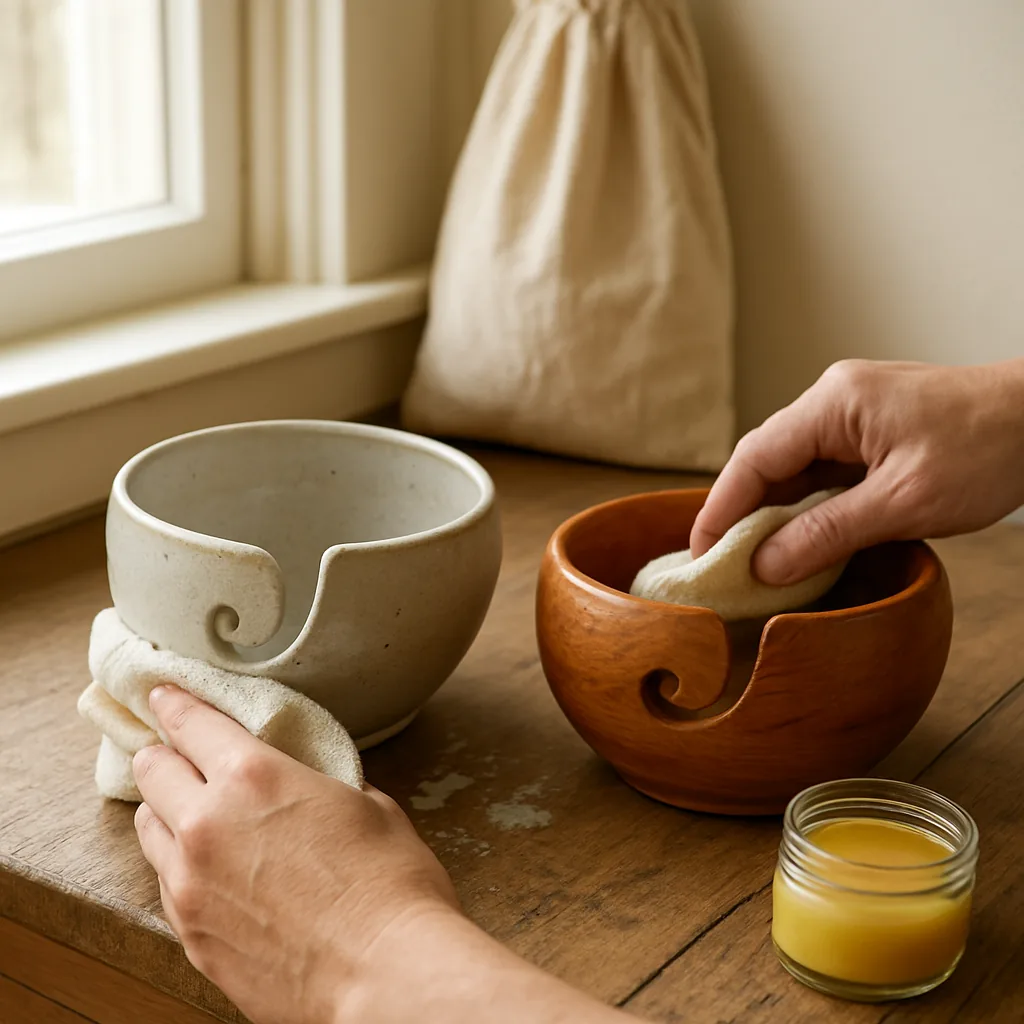
For care, the rule is simple: clean according to the material and check from time to time that no edge has lost its smoothness. If your holder has parts that come off, keep them together so nothing gets lost. If you use yarns that shed a lot of fluff, a quick wipe after each project stops it building up. For our own yarn bowl, the instructions are to use a dry or well-wrung damp cloth, keep it out of the dishwasher and away from radiators and long spells of direct sun. The spinning holder takes a dry or barely damp cloth and should never be submerged, because of the bearing.
Common mistakes when you start
These are the most common ones when someone begins to use a yarn holder and it does not quite click:
- Choosing for looks instead of use: a beautiful holder that does not take your usual ball is not much use. Start with how you work, and let the style come second.
- Ignoring the size of the ball: if the ball is too snug, the yarn comes out with resistance and your tension suffers.
- Not checking the edges: a rough edge can catch the fibre and spoil the yarn. Run your finger along it before the first use.
- Using an unstable holder: if it moves, you end up steadying it with one hand and crocheting with the other. Look for a non-slip base or a little more weight.
- Not thinking about transport: if you crochet away from home, a rigid, heavy model may stay on the shelf more often than you expect.
If you work with several colours
A yarn holder takes care of one ball at a time. If you work with several colours, you will want something extra to stop the strands from twisting around each other. Bobbins keep each colour in its own lane, and a dedicated colorwork set-up is worth planning before you cast on. Our “Color Dúo” bobbin system has a base, four removable bobbins and four front eyelets with rounded edges. If you are new to the technique, our guide to stranded colorwork knitting explains what you need to get started. And if you are also thinking about where everything lives between sessions, our advice on how to store yarn covers the rest of the stash.
Learn more: for a clear reference on yarn weight names (such as DK, worsted and bulky) and the usual hook and needle sizes for each, see the Craft Yarn Council's standard yarn weight system. It helps when a holder is described as suitable for chunky or bulky yarn.
From the Mota & Nudo workshop in Torremolinos: we design and 3D-print our accessories ourselves, from yarn holders to organizers. If you want to see options built around the way you work, take a look at both collections, and if you have a question, write to us. We like helping people find the accessory that really keeps them company. Better Together.
Frequently asked questions
Is a yarn holder worth it if I only crochet now and then?
If you crochet in short sessions and always in the same spot, a simple bowl may be all you need. If you notice the ball escaping, rolling off the sofa or tangling, a yarn holder saves you a lot of small interruptions. It is not essential, but it is very handy.
What is the difference between a yarn holder and a yarn bowl?
A yarn holder is the umbrella term for anything that holds the ball while you work: a bowl, a spinning stand, a wrist holder or a bag with a yarn guide. A yarn bowl is one type of yarn holder, usually a tabletop piece with a slot or spiral for the yarn. You will also see it called a wool bowl, especially in the UK.
Will any yarn holder work with chunky yarn?
Not necessarily. Chunky and bulky yarns need a wide opening and a roomy interior. If the ball is squeezed in, the yarn comes out with more resistance and your tension becomes uneven. Check the inner measurements before you buy, and think about the biggest ball you usually work from.
How do I clean a yarn holder?
It depends on the material. Wood and bamboo are wiped with a slightly damp cloth and dried well; ceramic and plastic can take mild soap and water; fabric holders follow the care label. Avoid harsh products that could damage the finish, and for our own 3D-printed pieces use a dry or well-wrung damp cloth and skip the dishwasher.
Can I use the same yarn holder for crochet and knitting?
Yes. The job is the same: hold the ball and let the yarn out smoothly. If you work with both hooks and needles, a versatile holder will serve for both crafts.